1. Introducing the idea of a Crypto-Body
Cryptocurrencies are often portrayed as volatile, lightly regulated, or tools for illicit activity. This view overlooks a deeper innovation: the Crypto-Body — a self-sustaining digital ledger system that is essentially a programmable and consensus-governed architecture for recording and automating diverse data and functions. Beyond serving as a store of value or payment rail, a Crypto-Body operates as a programmable institutional substrate whose rules are guaranteed by cryptographic verification. It validates data and transactions, allocates value and credit, enables exchange of verifiable digital assets, and coordinates these activities via energy and computation across individuals, firms, governments, and organizations — all while preserving anonymity and user privacy through pseudonymous identifiers and selective disclosure (e.g., zero-knowledge proofs), and still permitting auditability and legal compliance where required.
This article suggests five key criteria for a blockchain to qualify as a "Crypto-Body":
- Adoption Threshold. The network must attract a critical mass of users, validators, and on-chain activity to sustain itself economically. There needs to be enough demand for validation, and enough participants to satisfy that demand. The system cannot function as a self-sustaining entity without sufficient transactional and validator engagement.
- Fiat Infrastructure Threshold. The Crypto-Body has reached sufficient adoption for a robust "fiat infrastructure" to exist, enabling rapid two-way conversion between Crypto-Body tokens and fiat currency. This includes participation by banks, stablecoin issuers, and crypto exchanges, and where applicable, regulatory authorization for derivative products (e.g., ETFs and futures) referencing the Crypto-Body.
- Composability. It provides a general-purpose smart contract environment so that multiple functions and applications can interoperate on the same ledger. In practice, this means developers can compose complex services (finance, identity, governance, etc.) on one platform. Improved composability also reinforces the adoption threshold.
- Deterministic Logic. Outcomes are enforced by transparent code (smart contracts) rather than by opaque institutional processes. The rules are public and automatic, without requiring a discretionary decision by a central authority.
- Sustainable Incentives. The ledger has a built-in token mechanism that provides economic incentive for its own security and sustainable usage. For example, proof-of-stake blockchains reward validators through staking yields and may incorporate fee-burning mechanisms to reduce the circulating supply. These features provide economic returns and help secure the long-term viability of the network.
In short, a Crypto-Body is a broadly adopted, composable smart-contract platform operating on a public ledger, with robust fiat conversion infrastructure and durable incentive mechanisms that secure and sustain the network.
2. What Can a Crypto-Body Actually Do?
A programmable ledger unlocks applications beyond what fiat currency or static ledgers permit. Domains already explored include:
- Financial Contracts (DeFi). Decentralized finance protocols enable lending, borrowing, trading, and asset management without traditional intermediaries. Automated market makers and liquidity pools let users swap assets algorithmically. Billions of dollars now flow through such contracts on-chain, showing how a Crypto-Body can assume the role of banks and exchanges.
- Digital Identity and Credentials. Projects leverage blockchains for identity — from zero-knowledge ID systems that prove who you are without revealing sensitive data, to non-transferable "soulbound" tokens that serve as digital certificates or reputational badges. ENS maps readable names to wallet addresses, and Worldcoin aims to provide unique personhood attestations on-ledger.
- Registries for Ownership and IP. Blockchains act as tamper-proof registries for assets. NFTs demonstrate this for digital art and collectibles; similar logic is applied to supply chains (e.g. VeChain tracking goods provenance) and intellectual property rights. Governments are even testing blockchain-based land registries and certificate issuance.
- Governance via Token Voting (DAOs). A Crypto-Body can serve as a governance platform. DAOs use tokens to represent voting power, letting stakeholders make decisions transparently on-chain. The Optimism Collective pioneered on-chain governance for public-goods funding.
- IoT Integration. Smart contracts can respond to real-world data feeds (via oracles) and even control devices. Chainlink and IOTA have explored connecting IoT sensors and actuators to blockchain logic — imagine smart locks that open only when an on-chain condition is met, or insurance that pays out automatically on weather data.
Real-world examples hint at how Crypto-Bodies could undergird public infrastructure. Estonia's e-Residency program anchors some of its security on blockchain-like distributed logs. In finance, the Monetary Authority of Singapore and others have trialed cross-border payment networks on Ethereum-based platforms. The remainder of this article, however, focuses on monetary and banking functions — because a decentralized Crypto-Body can only be self-sustaining if it offers the right economic incentives, both for developers to build on it and for validators to secure it.
3. What is Wrong with Paper Money?
It is worth revisiting the challenges of traditional finance ("TradFi") to appreciate the Crypto-Body alternative. Today's financial system rests on three pillars: sovereign currency, commercial banks, and central banks.
- Sovereign Currency. National governments issue fiat money (like the US dollar), not backed by commodities but by public trust; legal tender laws mandate its acceptance.
- Commercial Banks. Private banks create most of the money supply by lending out deposits (the fractional reserve model). They act as custodians of deposits and as intermediaries allocating credit in the economy.
- Central Banks. Entities like the Federal Reserve or European Central Bank manage currency and bank liquidity. They set monetary policy and act as lenders of last resort to prevent financial crises.
This system has accomplished much but is prone to well-documented problems:
- Inflation and Currency Risk. History is littered with currencies that lost value due to over-issuance or loss of confidence. In extreme cases, fiat regimes implode in hyperinflation — Zimbabwe's dollar inflation hit an estimated 79.6 billion percent per month in late 2008. Even in mild cases, Argentina and Turkey suffer chronically high inflation that erodes savings.
- Bank Runs and Bailouts. Banks engage in maturity transformation: they borrow short and lend long, which makes them fragile by design. The bank fails if too many depositors demand their money back at once, as Diamond and Dybvig formalized in 1983. Government deposit insurance and central bank backstops exist to prevent panics, but these are imperfect — as 2008 demonstrated.
- Adverse Selection and Moral Hazard in Lending. Because banks lend other people's money, they do not always price risk with sufficient discipline. The subprime mortgage boom of the 2000s illustrates this vividly: lenders extended credit too freely, underestimating default risk.
- Opacity. A bank's true financial health can be hard for outsiders to gauge due to complex balance sheets or off-book exposures; research shows banks are "inherently more opaque" than other firms. Central banks themselves conduct much of their deliberation behind closed doors.
In summary, the current fiat-based system relies on trust in institutions: trust that governments will not debase currency, that banks will not gamble away deposits, and that regulators will act in time. When that trust falters, the consequences range from bank runs to currency crashes.
4. How Crypto-Bodies Can Reimagine Finance
Crypto-Bodies offer an alternate vision: trust in transparent code and math over trust in fallible human institutions. Blockchain-ledger systems like Bitcoin and Ethereum directly tackle TradFi pain points by design.
- Algorithmic Monetary Policy. Crypto networks replace central bankers with code. Bitcoin does it bluntly: a hard cap of 21 million coins, doled out on a fixed halving schedule. Ethereum rewrote its monetary logic entirely — in 2021 it began burning a portion of every transaction fee, and in 2022 it abandoned energy-intensive mining for proof-of-stake, rewarding users who lock up tokens to secure the network. Issuance dropped, and supply becomes elastic in the opposite direction compared to traditional monetary policy: increased usage makes ETH more scarce because more ETH is destroyed than created when activity rises. This is a radical break from Keynesian thinking, which all but assumes a growing economy requires a growing monetary supply. Ethereum's "monetary policy" is transparent, non-discretionary, and self-adjusting — a kind of algorithmic Federal Reserve that tightens when demand surges and eases when it slows.
- Yield by Protocol Design. In traditional finance, earning interest usually means trusting someone else with your money — putting it in a bank (hoping the bank does not fail) or buying corporate bonds (betting the company does not go bust). Crypto-Bodies like Ethereum offer a different model: yields come from helping keep the network running. On Ethereum, this is staking — locking tokens so the system can use them to validate transactions. In return, you earn rewards, typically 3–5% per year, paid directly by the network itself. Some call this crypto's version of a "risk-free rate," because you are not lending tokens to anyone but being paid for helping keep the system honest.
- Open Access and Self-Custody. Anyone with an internet connection can use blockchain-based financial services without a bank account, credit check, or permission. With a simple wallet, people can send money, earn interest, or borrow through platforms like Aave. Unlike traditional banks, these platforms do not hold your money for you — you hold it yourself, so your funds are not at risk if a company goes under. Because everything is tracked publicly on-chain, there are no hidden lending or surprise shortfalls. Bank runs in the traditional sense are not really possible — what you see is what exists.
- No Central Choke Points. In decentralized systems, control is spread across thousands of validators. No single institution's failure could crash the whole network. If a few validators break the rules, they lose money and the system keeps running. There is no central authority that can easily shut things down or block transactions across the board — the core infrastructure is designed to resist broad censorship.
That said, Crypto-Bodies face their own trade-offs:
- Volatility. Crypto assets used as currencies (like BTC or ETH) have exhibited far greater price volatility than fiat or even equities. Stablecoins partly solve this but introduce their own trust issues by relying on off-chain stores of value.
- Irreversibility and Bugs. "Code is law" can be brutally unforgiving: if a smart contract has a flaw, funds can be stolen or frozen and it is often permanent. The 2017 Parity wallet bug permanently locked over $150M USD in ETH. Finality cuts both ways — it prevents arbitrary reversals but means user errors or hacks can be catastrophic.
- Governance and Upgrades. Decentralized networks still need human coordination to upgrade protocols, which can lead to disputes and forks. The DAO hack (2016) split Ethereum into ETH and Ethereum Classic. More routinely, getting token-holders to vote is hard — turnout is low and voting power often concentrates.
- Usability and Security. Self-custody places a big burden on individuals. Managing private keys is difficult — lost keys mean lost assets forever (an estimated 20% of Bitcoin is lost). Wallet and DeFi UX is improving but remains intimidating for newcomers.
These are growing pains, not fatal flaws. Early financial systems in the 17th–19th centuries also suffered frequent crashes and scandals before modern reforms took place. Crypto-Bodies are likely in an analogous formative stage — learning, improving, and becoming more robust over time.
5. Ethereum, Solana, and Bitcoin: Who Fits the Definition?
Not all blockchains are created equal. Using the Crypto-Body lens, we can compare leading networks:
| Feature | Ethereum (PoS) | Solana (PoS) | Bitcoin (PoW) |
|---|---|---|---|
| Ledger Activity | Extensive. ~1.5M tx/day; rich DeFi/NFT activity. High on-chain "GDP." | Rising. Very high TPS capacity; tens of millions of daily tx (many are consensus messages). Growing DeFi/NFT usage, below Ethereum in value settled. | Basic. ~0.4M tx/day, mostly simple transfers. Limited expressivity keeps activity narrow. |
| Composability | High. Turing-complete smart contracts; thousands of dApps interlinked. L2s extend composability. | Moderate. Supports smart contracts (Rust-based). Growing app ecosystem, more siloed. | None. Script is intentionally not Turing-complete; Bitcoin cannot natively support complex dApps. |
| Deterministic Logic | High. Protocol changes go through transparent EIPs; consensus and state transitions are algorithmic and well-specified. | Moderate. Core is deterministic, but network has a history of coordinated restarts; reliance on a smaller validator set. | High (limited scope). Rules are hard-coded (21M cap, block time). Governance is conservative; scope of automation is minimal. |
| Incentive Structure | Robust. ETH staking yield (~3–4%) plus fee burns. Token economics designed for sustainability (low inflation, occasionally deflationary). | Workable. SOL staking yields are higher (~8%+) but come with higher inflation. No fee burn; outages have shaken confidence. | Sparse. Miners earn block rewards; ordinary BTC holders get no yield. Long-term security relies on fees and continued high price. |
Bitcoin remains the gold standard for secure, immutable record of value transfers — ultra-reliable at what it does, but purposely does very little. There is no integrated way to deploy new financial contracts on Bitcoin's base layer. That inflexibility maximizes security and simplicity at the cost of innovation.
Solana represents almost the opposite end: highly flexible and fast, with a design optimized for throughput. It powers NFT markets and DeFi apps with impressive speeds. However, its push for performance has sometimes come at the expense of resilience — multiple network-wide outages, and a more centralized validator set.
Ethereum, over time, has balanced decentralization with functionality. With hundreds of thousands of validators securing the chain after the switch to proof-of-stake, Ethereum is considered sufficiently decentralized to avoid any single point of failure. It is fully programmable, and its economic design post-2022 aims for sustainability: low issuance, often offset by fee burns, and users who stake earn returns without any off-chain intermediaries. No other blockchain of Ethereum's scale has this combination of composability, decentralization, and self-sustaining incentives. Ethereum is the closest real-world instantiation of a Crypto-Body as defined — a decentralized financial institution where the ledger itself is the platform for an entire economy's worth of activity.
6. Crypto Legislation and the Emergence of ETH as a Financial Instrument
Three pieces of 2023–2025 U.S. legislation are accelerating the mainstreaming of Crypto-Bodies, especially Ethereum:
1. The Digital Asset Market CLARITY Act (2025)
The House bill (H.R. 3633) provides a comprehensive framework for classifying digital assets — drawing a line between digital commodities and digital securities.
- Jurisdictional Clarity. The CFTC gains exclusive oversight of "digital commodities," while the SEC retains jurisdiction over "digital assets offered as part of an investment contract." For years tokens like ETH were in a gray area; CLARITY formally leans toward treating sufficiently decentralized tokens as commodities. The Act also creates a "Certification of Decentralization" process — Ethereum, with thousands of independent validators, is a prime candidate.
- Regulatory Framework. Exchanges dealing in crypto commodities must register as Digital Commodity Exchanges with the CFTC; AML laws apply. The onus is on crypto institutions to implement compliance, which also reassures traditional institutions.
- Impact on Ethereum. By likely cementing ETH's status as a commodity rather than a regulated security, the Act removes a major overhang. The Act's progress correlates with increasing talk of ETH spot ETFs (first approved by the SEC in May 2024) and even inclusion of ETH in retirement portfolios.
2. The GENIUS Act (2025)
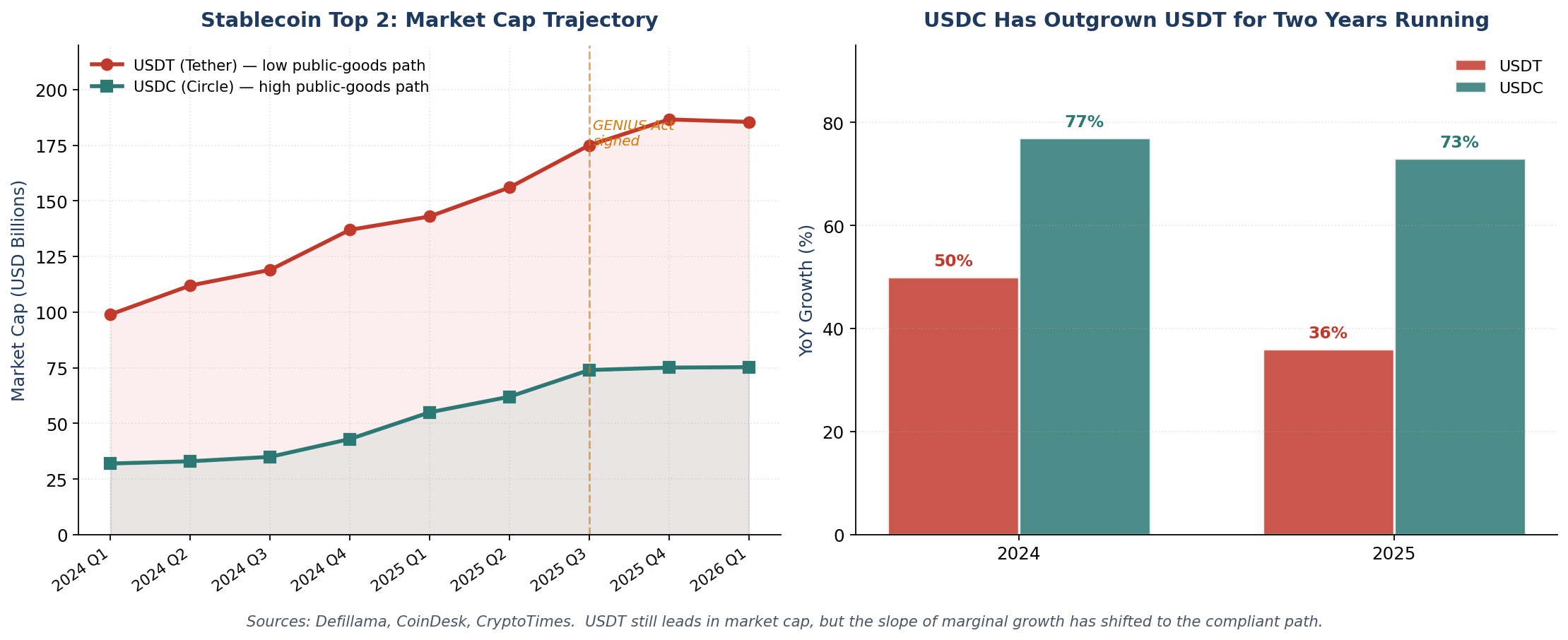
Signed in July 2025, the Guiding and Establishing National Innovation for U.S. Stablecoins Act is America's first federal law focused on stablecoins.
- Two-tier licensing. Small issuers (<$10B outstanding) can operate under state regimes with federal standards; large issuers must obtain a federal license. Companies like Circle (USDC) and Tether face bank-like scrutiny.
- Full reserve and transparency. Payment stablecoins must be 100% backed by high-quality liquid assets (short-term Treasuries, bank deposits, etc.) with monthly reserve disclosures. A stablecoin must essentially operate like a narrow bank.
- Consumer protections. Issuers are subject to Bank Secrecy Act obligations — KYC, transaction monitoring, freeze/blacklist capabilities where legally required. A concession to law enforcement, integrating stablecoins into the regulated perimeter.
- Why it matters for Ethereum. Most USD-backed stablecoins run on Ethereum. By legalizing and structuring the industry, GENIUS paves the way for much larger institutional use of stablecoins on open ledgers — cementing Ethereum's role as a global settlement layer for digital dollars. The law is pushing the crypto-dollar model rather than a Fed-issued CBDC.
3. The CBDC Anti-Surveillance State Act (2024)
Passed by the House in 2024, this bill prohibits the Federal Reserve from issuing a retail CBDC without Congressional approval. It was born from concerns that a U.S. CBDC could enable government surveillance of private transactions.
If the U.S. foregoes a government-run programmable dollar, the field is wide open for Ethereum and other public networks to fill that role. We can expect growth in USD stablecoins on Ethereum and adoption of privacy-preserving technologies. By banning a Fed CBDC, Congress is indirectly endorsing the crypto approach — leveraging open networks and private innovation to modernize payments rather than a top-down system.
7. Implications for ETH as an Asset
Ethereum's native token stands to gain a new narrative. It is transforming from just a "speculative cryptocurrency" into a bona-fide financial instrument with characteristics of multiple asset classes:
- Institutional access. With the introduction of spot ETH ETFs (first allowed to trade in July 2024), institutional investors can now get exposure through familiar vehicles — analogous to gold ETFs in the 2000s.
- Yield-bearing. ETH now provides a yield (from staking) on par with dividend stocks or bonds — around 3–5% annual rewards with relatively low variance. Analysts have started calling staked ETH "the new risk-free rate" in crypto.
- Regulatory derisking. The legislative clarity further derisks ETH in institutional eyes. As ETH is treated more like a commodity and stablecoin use on Ethereum gets official approval, ETH slots into portfolios as a long-term holding — a sort of digital oil that powers an economy of transactions, with fee revenue analogous to dividends.
One could argue ETH is becoming a multi-faceted asset: a commodity (fuel for using the network), a capital asset (producing yield for stakers), and quasi-equity (ownership giving a share of collective fees and upside from network growth). This "triple point asset" nature was theoretical in 2019; by 2025 it is visibly playing out. The EIP-1559 burn mechanism has at times made ETH deflationary when usage surges, directly tying economic activity to token scarcity — much like how stock buybacks increase equity value.
8. Conclusion: The Ledger Is the Institution
In the twentieth century, trust and coordination in society were mediated by paper contracts, corporate hierarchies, and government agencies. In the twenty-first, we are seeing the rise of ledgers, validators, and code as an alternative mode of coordination. Crypto-Bodies like Ethereum show that it is possible to have an institutional framework without traditional institutions — a public ledger that functions as courthouse, bank, and marketplace all at once.
This is a profound shift. A Crypto-Body is not just a coin or a payment system. It is a new species of institution: programmable (rules adjusted via code and smart contracts), auditable (everything transparent on-chain by default), and decentralized (no single party monopolizes control). Such an entity can hold and transfer value, enforce agreements, and adjudicate through code — without relying on conventional legal enforcement.
Ethereum, at present, is the most complete specimen of this phenomenon. It issues currency, manages savings (via staking), allocates capital (through DAO treasury votes and DeFi lending), and keeps records (property as tokens) — all on a ledger accessible worldwide. It is as if the functions of a central bank, a stock exchange, a notary public, and a clearinghouse were bundled into one open protocol.
The implications are only beginning to unfold. As regulations solidify and technology matures, we may witness ledgers becoming primary vehicles of policy (imagine welfare distribution via smart contracts), or even the law itself being coded (dispute resolutions by algorithm). The Crypto-Body concept urges us to rethink what a "financial institution" or "market institution" can be when jurisdiction is global and trust is algorithmic.
To conclude on a forward-looking note: if one asks "who regulates a Crypto-Body?", the answer might ultimately be the holders and the code — a form of self-governance that is neither anarchy nor traditional state control, but something in between. We are watching the birth of autonomous economic organisms, and much like the early internet, they will evolve, face setbacks, and challenge existing paradigms. The ledger-as-institution is here to stay; the open question is how it will coexist or compete with the institutions of yesterday.